
Guide
LLM SEO: how to get your brand into ChatGPT, Gemini and Perplexity answers
Last updated Prices checked
What people find when they search this term
The US results for "LLM SEO" and "SEO for LLMs" mix three things: explainers from SEO software companies, Google's own guidance on optimizing for its generative AI features, and research on measuring visibility in AI search. Tool lists ("LLM SEO tools") are a separate search with its own results.
The explainers agree on the basics. Google's guidance puts it plainly: unique, non-commodity content and foundational SEO matter more than any trick, and creating separate pages for every variation of a question to manipulate AI answers violates its scaled content abuse policy. The research side adds a measurement point: AI answers change across runs, prompts and time, so visibility is better described as a rate than a single result.
This page keeps the parts you can act on, and is clear about what nobody can promise.
Two ways an LLM learns about your brand
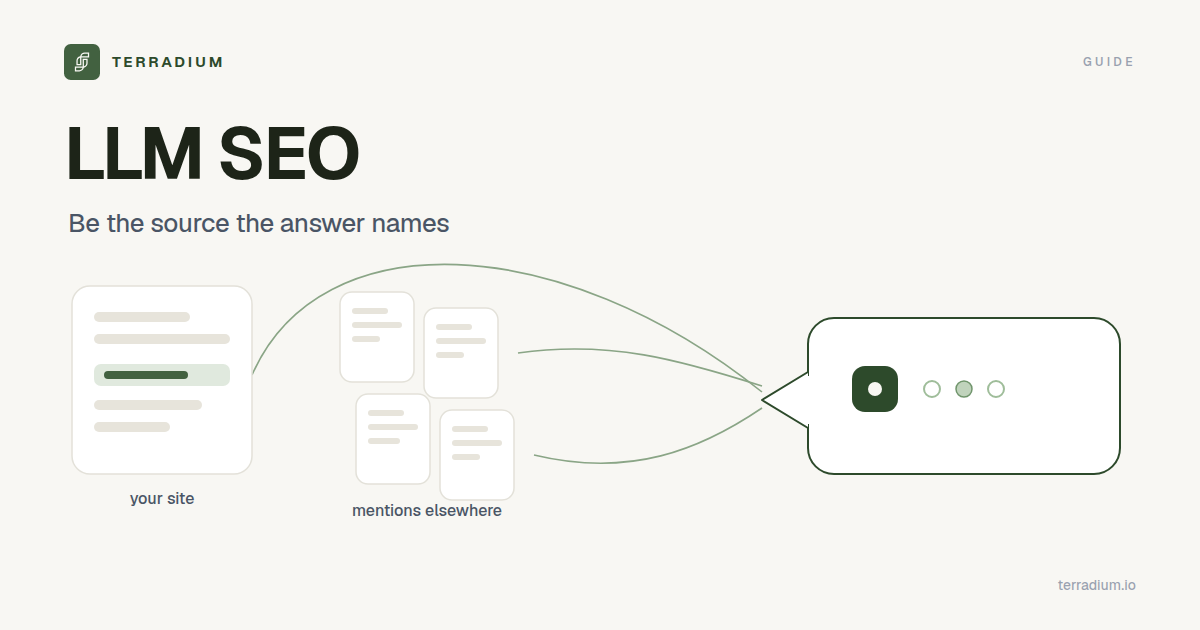
An answer that mentions your brand usually comes from one of two places:
- Live retrieval. The assistant searches the web while answering, reads a few pages, and cites some of them. ChatGPT with search, Perplexity, Google AI Overviews and Gemini all do this for many questions (see AI answer engines and Perplexity SEO). This is the part you can influence quickly: if your page is retrievable and answers the question clearly, it can be picked.
- What the model already absorbed. Without searching, a model answers from patterns in the text it was trained on. If your brand was rarely mentioned across the web, the model has little to say about it. This changes slowly and you can't edit it directly; it follows from being written about.
Most LLM SEO work targets the first, while consistent mentions across the web help with both.
What stays the same from classic SEO
- Crawlable, server-rendered pages. Most AI crawlers don't run JavaScript. If your text only appears after scripts load, the crawler may see an empty page.
- Indexing and access. Pages behind logins, broken redirects or blocked crawlers can't be retrieved or cited.
- Useful, original content. A page with a real point of view or first-hand detail beats a summary of what everyone else already says.
- Clear structure. Headings that match questions, short sections, and internal links that tie a topic together.
What changes
| Classic SEO | LLM SEO | |
|---|---|---|
| What you get | A position in a list of links | A mention or citation inside one answer |
| Unit that wins | The page | Often a passage that answers part of the question |
| Who you need to allow | Search engine crawlers | AI crawlers too: GPTBot, OAI-SearchBot, ClaudeBot, PerplexityBot, Google-Extended and others |
| How a question is handled | Matched to pages | Often split into several sub-searches first (see query fan-out) |
| How you measure | Rank and clicks | Sampled appearance rate, citation share, share of voice, and AI referral visits |
In practice that means: put the direct answer at the top of the page and of each section, make each section make sense on its own, use the format the question calls for (steps, a table, a short definition), and keep facts specific and current. An llms.txt file gives AI crawlers a plain map of your key pages; it doesn't force anything, but it's cheap to publish.
LLM seeding: being mentioned where models look
"LLM seeding" is the off-site half of LLM SEO: getting your brand mentioned on the pages that AI answers already lean on, such as comparison articles, review and directory sites, community threads and documentation. If those pages list your competitors and not you, an answer built from them is likely to do the same.
The honest version of seeding is ordinary marketing work: earn genuine coverage, get listed where buyers compare options, answer questions in communities where you have something useful to say, and keep your own facts consistent everywhere. Paid placements and mass-posted comments are easy to spot and tend to backfire. Seeding works best when there's a clear, quotable page on your own site for those mentions to point back to.
How to measure LLM SEO
Because answers vary, one screenshot proves little. See does ChatGPT give the same answers to everyone?. Measure by sampling: ask the questions your buyers ask, on a schedule, across the engines that matter to you, and record what comes back.
- Appearance rate: how often your brand is mentioned for a question.
- Citation share: how often your site is one of the cited sources.
- Share of voice: how often you're cited compared with competitors.
- AI referral visits: which visitors actually arrived from an AI answer. Many AI referrals show up as "direct" in analytics unless you attribute them. See AI traffic analytics.
These are directional numbers. They tell you whether new pages and new mentions are moving things. Questions where a competitor is cited and you aren't are your next pages to write. For a closer look at trackers, see AEO tracker.
Where Terradium fits
Terradium writes content built to be cited, tracks where AI engines pick you up, and shows which visitors came from an AI answer.
- AI Visibility: 15 tracked questions, sampled weekly, on 3 answer engines of your choice (ChatGPT, Perplexity, Google AI Overviews, or Gemini), with appearance rate, citation share, and share of voice.
- 30 answer-ready article generations per billing period, published to a built-in headless CMS or a signed webhook.
- Embed SDK (
npx terradium init) for AI-referral attribution. - Google Search Console integration and an MCP server.
- $29/month, 7 days free, then billed monthly. Cancel anytime. See pricing.
Terradium handles the on-site pages and the measurement. It doesn't do off-site seeding for you; it shows you whether that work, and your pages, are changing what AI answers say.
Free tools: the AI crawler checker checks whether robots.txt allows 13 AI crawlers, whether your llms.txt is valid, and whether a page is server-rendered. The AI visibility checker asks ChatGPT and Google AI Overviews one question and reports whether each answer mentions your brand and cites your domain.
FAQ
- What is LLM SEO?
- The work of getting large language models such as ChatGPT, Gemini, Perplexity and Google AI Overviews to name your brand and cite your pages in their answers.
- Is LLM SEO different from SEO?
- It builds on the same foundations: crawlable pages, clear structure, useful content. The difference is the goal and the measurement: a mention or citation inside one answer, measured by sampling, instead of a rank in a list of links.
- Is LLM SEO the same as GEO or AEO?
- They're overlapping names for the same goal. See the AEO definition and AI discoverability.
- What is LLM seeding?
- Getting your brand mentioned on the third-party pages AI answers draw from, such as comparison articles, reviews, directories and community threads, through genuine coverage rather than paid links.
- How do I know if LLM SEO is working?
- Sample the same buyer questions on a schedule and track appearance rate, citation share and share of voice, plus visits that arrive from AI answers.
- Can anyone guarantee my brand will appear in ChatGPT?
- No. Answers vary by run, wording and model. You can make your pages eligible, earn mentions, and measure the trend.
Start the 7-day free trial
Start the 7-day free trial · Check your AI crawler access free
See where AI answers leave you out
Terradium samples ChatGPT, Perplexity, Google AI Overviews and Gemini for the questions your buyers ask, then writes the articles that close the gaps. $29 a month, 7 days free.
Start free for 7 days