
Guide
AI visibility score: what it measures and the four numbers behind it
Last updated Prices checked
What people find when they search "AI visibility score"
The US results are free AI visibility checkers that return a 0–100 score, vendor pages explaining their scoring methodology, and guides from marketing platforms on which metrics to track. They agree on two things: a score is built from mentions, citations, and competitor comparison, and it should be read as a trend, not an absolute grade. This page explains what goes into a score, why scores from different tools can't be compared, and which underlying numbers to watch.
What an AI visibility score is
AI answers don't have a fixed rank. The same question can return different sources on different runs, and small changes in wording shift who gets quoted (see does ChatGPT give the same answers to everyone?). So AI visibility is measured by prompt sampling: ask the same set of questions repeatedly, on a schedule, and record what comes back.
A score rolls those samples into one number. Typical inputs:
- Whether the brand is mentioned in the answer text.
- Whether the brand's domain is cited as a source.
- Where the brand appears when the answer lists several options.
- How the brand compares with competitors on the same questions.
- Which engines the brand shows up on.
Why two scores don't compare
A score depends on choices made before any answer is sampled:
| Choice | Why it changes the number |
|---|---|
| The question set | Branded questions ("is X good?") score high because the brand is already in the prompt. Unbranded buyer questions are harder and more useful. |
| The engines | A brand can be cited often in one engine and rarely in another. |
| The competitors | Share-based metrics move when the competitor list changes. |
| The sampling cadence | Weekly and daily sampling see different amounts of run-to-run variation. |
| The market | Google AI Overviews are geographic: the same question returns different sources in different countries. |
| The weighting | One tool may weigh mentions above citations, another the reverse. |
So "our score is 62" means little on its own. "Our score on the same 15 questions and the same three engines went from 48 to 62 in a quarter" means something.
The four numbers behind the score
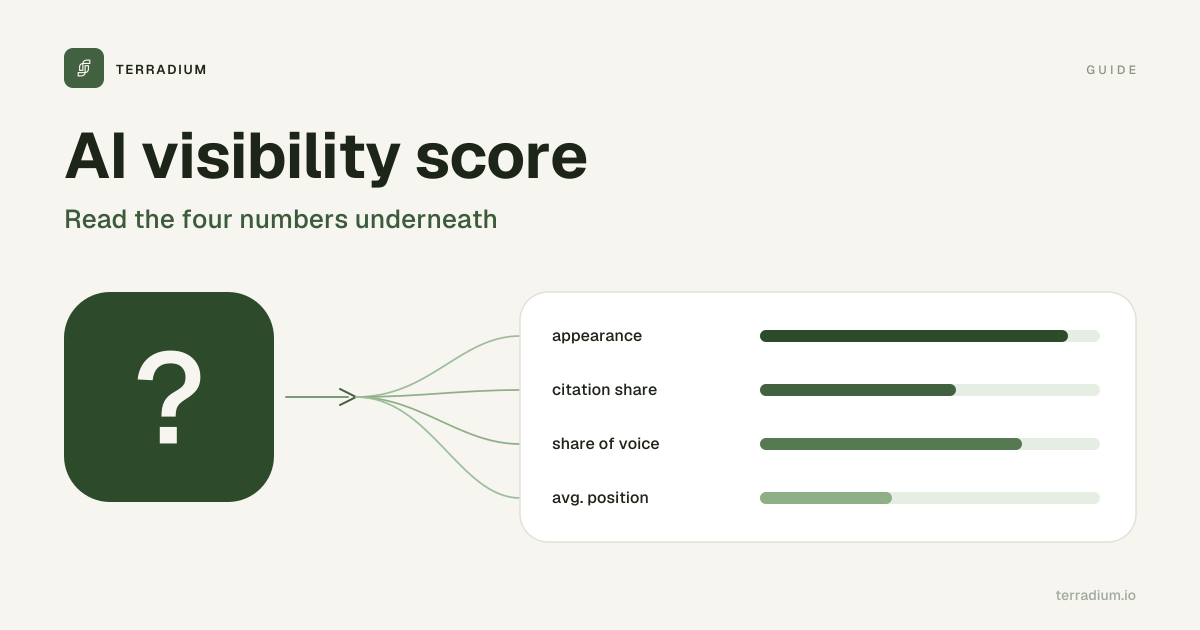
Instead of one blended number, read the parts. These four are the ones Terradium reports:
| Metric | What it measures | What it tells you |
|---|---|---|
| Appearance rate | Share of sampled prompts where your brand shows up at all, mentioned or cited | Whether you're in the answers at all |
| Citation share | How often you're the named source the engine links or attributes its answer to | Whether your own pages are doing the work |
| Share of voice | Your slice of the cited sources versus the competitors on the same prompts | Who wins the questions you lose |
| Average position | Where you tend to land among the cited sources when you do appear | Whether you're the lead source or a footnote |
Mentions and citations are not the same number. A brand can be named in an answer while a competitor's comparison page is the cited source. Citations are what your own pages can influence most directly, so track them separately (more in ChatGPT SEO).
AI share of voice, explained
Share of voice in AI search is your portion of the visibility on a set of questions, compared with the competitors you track on those same questions. In Terradium it's measured on cited sources: of all the sources the engines cite across your sampled prompts, how many are yours versus each competitor's.
It's the most useful number for a buyer-facing team because it answers a competitive question directly: when someone asks an AI assistant about your category, who gets quoted? A rising appearance rate with a flat share of voice means the whole category is getting more visible, not you in particular.
Three rules keep it honest:
- Fix the competitor list. Adding or dropping a competitor changes everyone's share.
- Use unbranded questions. Share of voice on questions that already name you is inflated.
- Compare per engine as well as overall. A strong overall share can hide an engine where a competitor wins every time.
How to measure it without fooling yourself
- Start with buyer questions. "Best X for Y", "X vs Y", and "how do I solve Z" questions are closest to a purchase.
- Keep the set stable. Change the questions and you reset the trend.
- Sample on a schedule. One check is a screenshot. A rate across many samples is a measurement.
- Look at the answers, not only the number. If you can't open the answers behind a score, you can't tell why it moved.
- Tie a change to an action. When you publish a page aimed at a question you lose, watch that question's citation share in the next scans.
What a score can't tell you
- Not a guaranteed placement. Sampled metrics are directional trends.
- Not traffic. Many AI answers are read without a click. Track AI referrals separately (see AI traffic analytics).
- Not a crawl check. If AI crawlers can't fetch your pages, no amount of content will raise the score. Check access first with the free AI crawler checker.
How Terradium reports AI visibility
To check one question right now, Terradium's free AI visibility checker asks ChatGPT and Google AI Overviews and shows whether each answer mentions your brand and cites your domain. No sign-up for one question; an email unlocks up to 10 questions and a weekly re-check.
For tracking over time, Terradium samples your questions on the engines you choose (ChatGPT, Perplexity, Google AI Overviews or Gemini) and reports appearance rate, citation share, share of voice and average position, each as a current value plus a trend, per engine and rolled up. The $29 plan tracks 15 questions weekly across 3 engines, with 7 days free. The Actions list then names the tracked questions you lose, the competitor pages cited instead, and offers to draft an article aimed at that gap, so the next scans show whether the citation rate moved. Details in the AI Visibility docs.
Comparing trackers is a separate decision. The AEO tracker guide covers what to look for.
FAQ
- What is an AI visibility score?
- A summary number for how often AI answer engines mention your brand or cite your site across a fixed set of sampled questions.
- How is an AI visibility score calculated?
- There's no standard formula. Most combine mention rate, citations, position in the answer, and comparison with competitors, weighted differently by each tool. Ask any tool which inputs and weights it uses.
- What is a good AI visibility score?
- There's no universal benchmark. A good score is one that rises on the same questions, engines, and competitor set over time, and that beats your competitors on the questions your buyers ask.
- What is AI share of voice?
- Your share of the visibility in AI answers compared with the competitors you track on the same questions. Terradium measures it on cited sources.
- Can I compare scores from different tools?
- No. Different question sets, engines, competitors, cadences, and weights produce different numbers. Compare a tool's score only with its own history.
- How often should I measure AI visibility?
- On a fixed schedule, so the trend reflects real change rather than run-to-run variation. Terradium's $29 plan samples weekly.
- Can I check my AI visibility for free?
- Yes, for one question at a time with the free AI visibility checker, which checks ChatGPT and Google AI Overviews.
Check your AI visibility
Check your AI visibility, free · Start the 7-day free trial
See where AI answers leave you out
Terradium samples ChatGPT, Perplexity, Google AI Overviews and Gemini for the questions your buyers ask, then writes the articles that close the gaps. $29 a month, 7 days free.
Start free for 7 days