
Guide
AI visibility optimization: a practical playbook for getting recommended by AI answers
Last updated Prices checked
What people find when they search "AI visibility optimization"
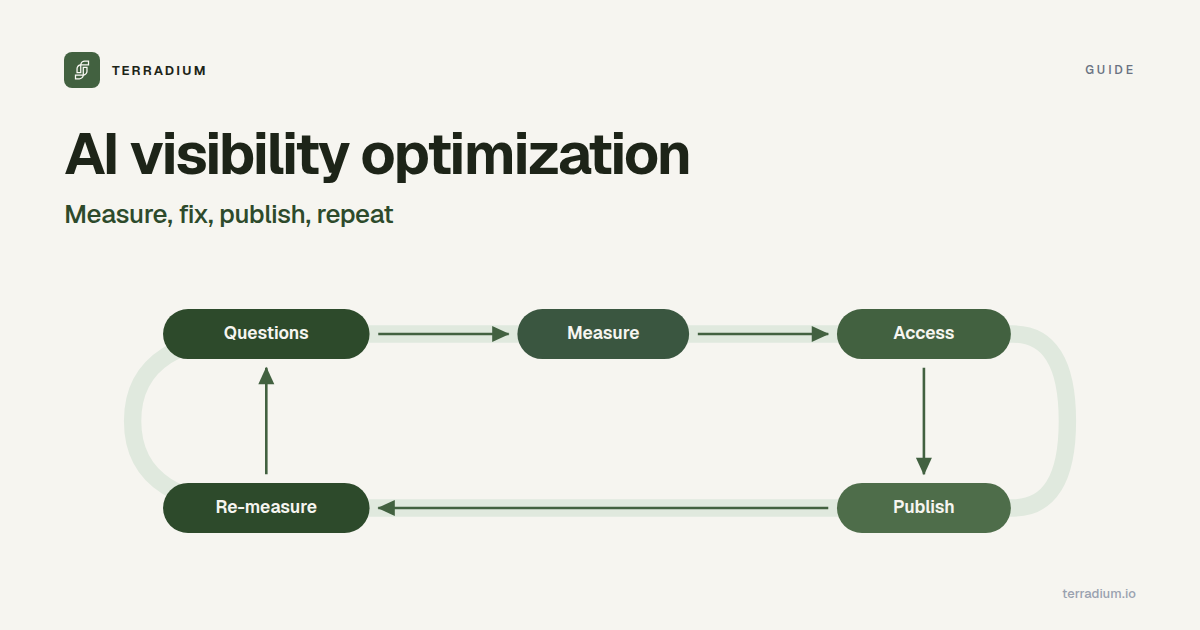
The US results are a mix of definitions of the term, Google's own guide to optimizing for generative AI features, listicles of AI-visibility tools, and agency service pages. Most agree on the shape of the work: be crawlable, write clear answers, earn mentions elsewhere. What they often skip is the measurement loop. This page is the loop, in order, so you can start without buying anything.
What AI visibility optimization is (and isn't)
- It is getting your pages used as sources and your brand named in answers to buyer questions.
- It is not a ranking position. AI answers are generated per question and vary between runs (see does ChatGPT give the same answers to everyone?), so "rank" gives way to appearance rate and citation share.
- It is not a replacement for SEO. Several engines draw on search indexes, so crawlable, indexed, useful pages still come first. See AEO definition for the practice itself and LLM SEO for the cross-engine view.
Step 1: Pick the questions buyers ask
Start with 10 to 20 questions a buyer would ask before choosing a product like yours: "best X for Y", "X vs Z", "how do I do W", pricing and fit questions. Write them as people phrase them to a chatbot, in full sentences. Keep the list; it is your test set for every later step. Search Console queries you already earn impressions for are a good source (see AI discoverability).
Step 2: Measure a baseline
Before changing anything, record for each question and engine: does the answer name you, does it link or cite your pages, and who is named instead. One check is a screenshot. Because answers vary, sample the same questions on a schedule and read the result as a rate.
The metrics worth tracking are appearance rate, citation share, share of voice against competitors on the same questions, and average position where the answer lists brands (see AI visibility score). For a quick one-off look, the free AI visibility checker asks ChatGPT and Google AI Overviews one question at a time.
Step 3: Make your pages reachable
If an AI crawler can't read the page, nothing else matters.
- robots.txt. Check what you allow or block for AI crawlers, including Google-Extended. Blocking the wrong token can remove you from the surface you want to appear in (see Gemini SEO and GPTBot).
- Server-rendered text. Many AI crawlers don't run JavaScript. Make sure the main text is in the raw HTML.
- llms.txt. Optional and not a ranking lever, and Google says it ignores it; keep one if you want it for other engines (see an llms.txt example).
The free AI crawler checker shows what your robots.txt says to 13 AI crawlers, plus llms.txt and whether the content is in the raw HTML.
Step 4: Publish answer-ready pages
For each question on your list that you can answer honestly, make sure one page answers it directly:
- Lead with the answer. A short, self-contained answer in the first paragraph, then detail.
- Use headings that match the question. Engines pull passages, so each section should stand on its own.
- Publish the facts only you have. What your product does and doesn't do, published prices and limits, who it's for. Generic tips are interchangeable; specifics are citable.
- Add an FAQ for the follow-up questions buyers ask next.
- Don't spin up a page per phrasing. Engines can fan one question out into several searches (see query fan-out). Cover sub-questions inside pages that deserve to exist.
- Be present where engines look. Engines also cite third-party pages. Look at which outside pages they cite for your questions and work on being represented accurately there.
Step 5: Re-measure and repeat
After you publish or fix something, wait for the next sampling run, then compare against the baseline. Keep what moved the rate, drop what didn't. Also watch referrals separately, since many AI answers are read without a click (see AI traffic analytics).
Optimization vs. tracking vs. agencies
| Do it yourself with a tracker | Agency or service | |
|---|---|---|
| What you get | The measurement loop and the data; you write and fix | Someone else runs parts of steps 1 to 5 |
| Best when | You have a content owner and want to see the numbers | You want the work done for you |
| Watch for | Tracking without acting | Reports without a baseline you can check yourself |
Either way, insist on the same baseline: the same questions, sampled the same way, over time. See generative engine optimization agencies if you're comparing services, and AI rank tracker for tracking.
Where Terradium fits
Terradium covers the loop. AI Visibility samples your tracked questions on ChatGPT, Perplexity, Google AI Overviews, and Gemini, and reports appearance rate, citation share, share of voice, and average position, per engine and rolled up, each as a current value plus a trend. The $29 plan samples 15 tracked questions weekly on 3 engines of your choice. Connect Google Search Console and Actions lists queries you already earn impressions for, so you can track them in AI answers. To write the pages, Terradium includes 30 answer-ready article generations per billing period, published to a built-in headless CMS or a signed webhook. $29/month, 7 days free, then billed monthly. For AI Overviews, sampling uses the country and language in your project's brand profile.
FAQ
- What is AI visibility optimization?
- The ongoing work of getting your brand named and your pages cited in AI answers: choose buyer questions, measure how often you appear, fix access, publish answer-ready pages, and re-measure.
- Is AI visibility optimization the same as GEO or AEO?
- They overlap. GEO (generative engine optimization) and AEO (answer engine optimization) are names for the same family of work. This page treats it as a measurable loop. See AEO definition.
- How long does it take to see results?
- It depends on your site, your market, and how often engines refresh what they use, so no honest number applies to everyone. Sample the same questions on a schedule and compare against your baseline.
- Can anyone guarantee that AI will recommend my brand?
- No. Answers vary between runs, so aim to raise your appearance rate and track it.
- Do I need llms.txt?
- It isn't required, and Google says Google Search ignores it. Keep one if you want it for other engines.
- How do I check whether AI crawlers can read my site?
- Use the free AI crawler checker: it shows what your robots.txt says to 13 AI crawlers and whether your content is in the raw HTML.
- Can Terradium track my brand across AI engines?
- Yes: ChatGPT, Perplexity, Google AI Overviews, and Gemini. The $29 plan samples 15 questions weekly on 3 engines you choose.
Start the 7-day free trial
Start the 7-day free trial · Check your AI crawler access free
See where AI answers leave you out
Terradium samples ChatGPT, Perplexity, Google AI Overviews and Gemini for the questions your buyers ask, then writes the articles that close the gaps. $29 a month, 7 days free.
Start free for 7 days