
Guide
GEO audit: how to check if AI search can read, mention and cite you
Last updated Prices checked
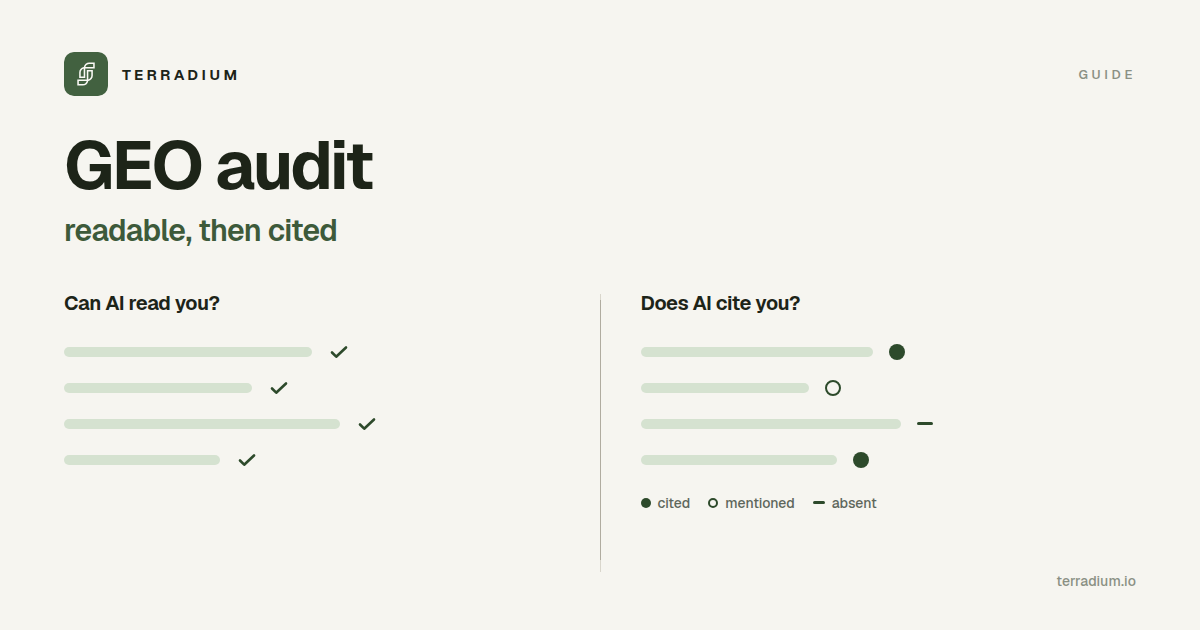
What people find when they search "GEO audit"
The US results are a mix of free audit tools that score a list of signals, long checklists of fixes, and agency pages explaining what an audit covers. Most of them focus on the technical side: robots.txt, structured data, llms.txt, rendering. That's necessary, but it only tells you whether AI engines could cite you. This page covers both halves, and explains why an audit is a baseline you re-run rather than a one-off report.
What a GEO audit is
An SEO audit asks whether search engines can crawl, index and rank your pages. A GEO audit asks the equivalent for AI answers:
- Can the engines read you? If an AI crawler is blocked or gets an empty page, there's nothing to quote.
- Do the engines use you? Whether your brand is named, and whether your pages are the sources an answer links or attributes to.
- Who do they use instead? For every question you lose, which competitors and which pages were cited.
The output should be a short list of fixes and gaps, not a single score. (If you want a score, the AI visibility score guide explains what goes into one and why two scores rarely compare.)
Half one: can AI crawlers read your site?
These checks are deterministic. Run them once, fix what fails, and re-run after every deploy that touches templates, rendering or robots.txt.
- robots.txt, per AI crawler. Training crawlers (such as GPTBot, ClaudeBot and the Google-Extended token) and search or browsing crawlers (such as OAI-SearchBot, ChatGPT-User, Claude-SearchBot and PerplexityBot) are separate user agents. Blocking a training crawler keeps you out of future training data; blocking a search crawler stops live answers from citing you. See GPTBot for the trade-off.
- Content in the raw HTML. Most AI crawlers download the HTML and don't run JavaScript. A client-rendered app shell looks empty to them, however good the page is in a browser.
- Same content for bots and browsers. A firewall or bot rule that blocks AI crawlers, or serves them something different, fails here.
- Page basics. Title, meta description, H1, canonical, and JSON-LD structured data.
- Discoverability files. robots.txt, sitemap.xml, and an llms.txt (plus llms-full.txt) that follows the llmstxt.org format. See the llms.txt example.
Half two: do AI answers mention and cite you?
This is the half most audits skip, and the one that tells you whether the fixes worked.
- Write down the buyer questions. Comparisons, "best X for Y", "how do I solve Z". Your Search Console queries are a good source of real wording.
- Ask them on the engines your buyers use. Measure each engine separately. Google's AI Overviews also vary by country and language.
- Record three things per answer. Were you mentioned? Were you cited, and which page? Who was mentioned or cited instead? The difference between a mention and a citation is covered in AI brand mentions.
- Repeat it. Answers vary from run to run (see does ChatGPT give the same answers to everyone?), so one pass is an anecdote. The rate across repeated samples is the signal.
A GEO audit checklist
| Check | What to look for | How to check |
|---|---|---|
| AI crawler access | Search and browsing crawlers allowed for the pages you want cited | robots.txt rules per user agent |
| Raw HTML content | Main text present in the initial HTML response | Fetch the page without JavaScript, or as GPTBot |
| Bot vs browser parity | Crawlers get the same content a browser does; no firewall blocking AI bots | Compare both responses |
| Page basics | Title, meta description, H1, canonical present | Page source |
| Structured data | JSON-LD for the organization, author and article | Page <head> |
| Discoverability files | robots.txt, sitemap.xml, llms.txt, llms-full.txt | Fetch each at the domain root |
| Mention rate | Share of buyer questions where you're named | Repeated sampling per engine |
| Citation share | How often your pages are the cited source | Repeated sampling per engine |
| Competitor gaps | Questions where a competitor is cited and you aren't, and which pages | Citations recorded per answer |
One-off audit vs ongoing measurement
A one-off audit is the right start: it finds the blocked crawler, the empty app shell, the missing llms.txt. But passing every readability check doesn't mean AI answers will cite you, and a single round of visibility checks can't tell a real change from run-to-run noise.
So treat the audit as a baseline. Fix the readability half once and re-check after deploys. Sample the visibility half on a fixed schedule and read the trend. Then work on the questions you lose, as described in AI visibility optimization.
How to run a GEO audit with Terradium
Start free. The AI crawler checker tests one URL with no sign-up:
- robots.txt rules for 13 AI crawlers (GPTBot, OAI-SearchBot, ChatGPT-User, ClaudeBot, Claude-SearchBot, Claude-User, PerplexityBot, Perplexity-User, Google-Extended, Applebot-Extended, meta-externalagent, CCBot and Bytespider), evaluated against your page's path.
- Your llms.txt: whether it exists, whether it's really your app shell served for a missing file, and whether it follows the llmstxt.org format. It also checks for llms-full.txt.
- Server-rendered content: it fetches the page as GPTBot, measures the text in the raw HTML, compares it with what a browser gets, and flags a firewall that blocks AI crawlers, missing title, description and H1 tags, and missing JSON-LD.
The free AI visibility checker covers a first look at the second half: ask one buyer question and see what ChatGPT and Google's AI Overview say about you.
Then make it ongoing. In the Terradium app (pricing):
- GEO Readiness re-fetches your live site and grades it across four groups: Setup, Published page, Discoverability files, and Crawler access. Every failing check explains what's wrong and gives a copy-paste fix prompt for your AI coding agent. Checks marked "blocks publishing" hold auto-publish until they pass, so scheduled articles aren't pushed into a site AI crawlers can't read.
- AI Visibility samples your tracked questions on ChatGPT, Perplexity, Google AI Overviews and Gemini, and reports appearance rate, citation share, share of voice and average position as current values plus trends. The $29 plan tracks 15 questions, sampled weekly, on 3 engines of your choice.
- Actions turns each scan into this week's list: tracked questions you lose, the engines where no sampled answer cited you, and the competitor pages that were cited.
$29/month, 7 days free, then billed monthly. Details in the AI Visibility docs.
Related: the blog guide to AI search visibility checkers and GEO audits, query fan-out, and GPTBot.
FAQ
- What is a GEO audit?
- A check of whether AI answer engines such as ChatGPT, Perplexity, Gemini and Google's AI Overviews can read your site, and whether their answers mention and cite you for the questions your buyers ask.
- What does a GEO audit check?
- Two halves. Readability: AI crawler access in robots.txt, content in the raw HTML, bot vs browser parity, page basics, JSON-LD, and discoverability files like sitemap.xml and llms.txt. Visibility: how often you're mentioned and cited across repeated samples, and which competitors are cited instead.
- Is a GEO audit the same as an SEO audit?
- No. They overlap on crawlability and page basics, but a GEO audit also checks AI-specific crawlers, whether content works without JavaScript, llms.txt, and how AI answers actually treat your brand.
- Can I run a GEO audit for free?
- The readability half, yes. Terradium's free AI crawler checker tests robots.txt for 13 AI crawlers, llms.txt, and server-rendered content for one URL, with no sign-up.
- How often should I run a GEO audit?
- Re-run the readability checks after deploys that change templates, rendering or robots.txt. Sample the visibility half on a fixed schedule, such as weekly, and read the trend.
- Should I block GPTBot?
- It's your call. Blocking a training crawler like GPTBot keeps you out of future training data but doesn't stop live answers citing you. Blocking search crawlers such as OAI-SearchBot or PerplexityBot does.
- What does Terradium's GEO Readiness check cover?
- Four groups: Setup, Published page, Discoverability files, and Crawler access. Each failing check comes with an explanation and a copy-paste fix prompt.
- Does passing a GEO audit guarantee AI citations?
- No. It removes the reasons an engine can't cite you. Whether it does depends on how well your pages answer the question compared with other sources, which is why the visibility half is measured as a trend.
Start the 7-day free trial
Start 7-day free trial · Check your site free
See where AI answers leave you out
Terradium samples ChatGPT, Perplexity, Google AI Overviews and Gemini for the questions your buyers ask, then writes the articles that close the gaps. $29 a month, 7 days free.
Start free for 7 days